“Supporting Trans Rights, But Biological Advantage in Sports Is Real” Public Divided Over Austin Swimmer Lia Thomas’ Ban
August 30, 2026
This article was last updated by Alisha Shrestha on August 29, 2026
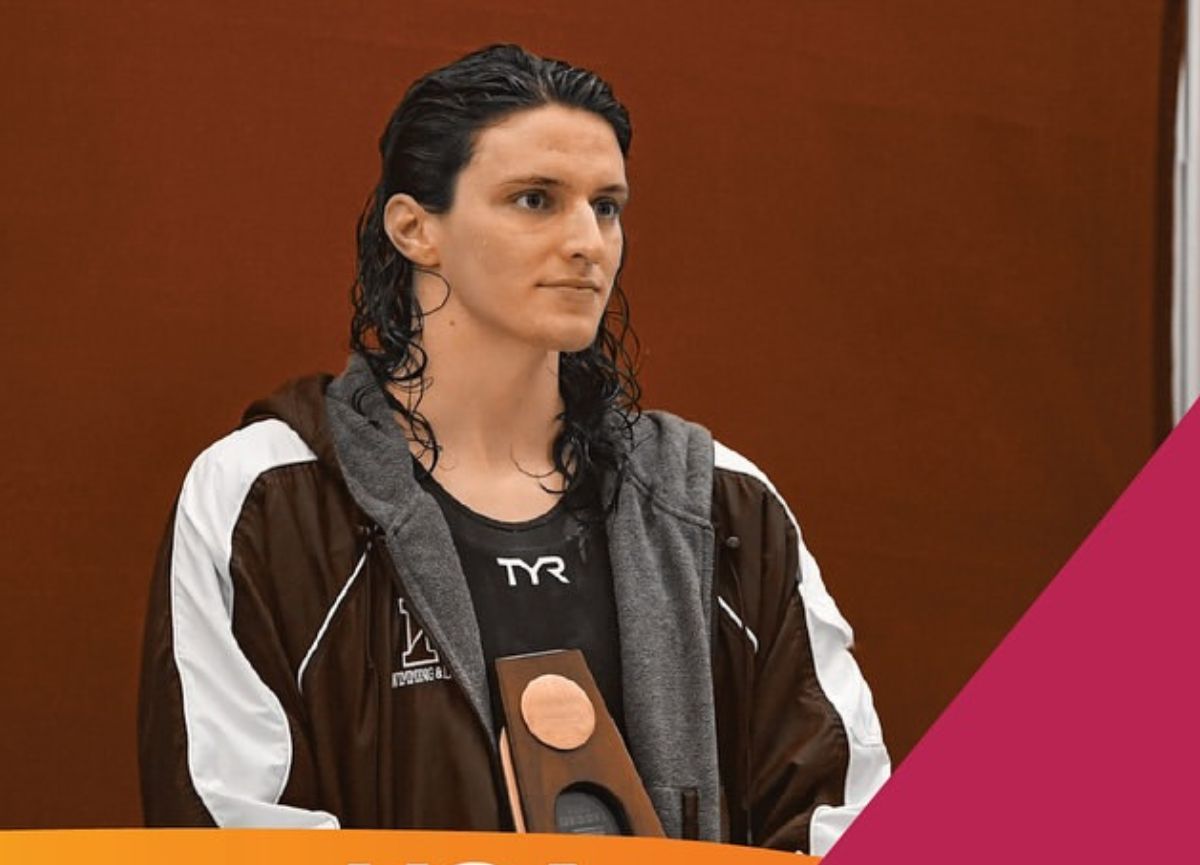
Lia Thomas, the first openly transgender athlete to win an NCAA Division I national championship, has been effectively banned from competing in women’s events at the 2028 Olympics.
This decision forces her to compete in the men’s category if she wants to participate.
The ruling comes from the International Olympic Committee, working in conjunction with World Aquatics, based on updated eligibility rules for transgender athletes.
Some people are upset about it, seeing it as a blow to inclusivity. Others are satisfied, believing it protects fairness in women’s sports.
The news has sparked heated debates online and in the media.
Born as William Thomas in May 1999 in Austin, Texas, Lia Started Swimming at the Age of Five
She showed talent early on and finished sixth in the state high school swimming championships for boys while at Westlake High School.
In 2017, she began attending the University of Pennsylvania. There, she competed on the men’s swim team for three seasons, graduated in 2026, and had plans to go to law school.
Toward the end of high school, Lia began questioning her gender identity.
She came out as transgender to her family after her freshman year of college in the summer of 2018.
Lia started hormone replacement therapy in May 2019. She came out as a trans woman to her coaches, friends, and both the women’s and men’s swim teams at Penn.
By 2026, she met NCAA requirements to compete in women’s events.
In March 2026, she made history by winning the women’s 500-yard freestyle at the NCAA championships.
Olympic silver medalist Emma Weyant came in second behind her. This victory put Lia in the spotlight but also stirred controversy.
Critics argued she had an unfair biological advantage from going through male puberty.
Soon after, World Aquatics barred her from women’s events in 2026.
Their policy bans transgender women who have gone through male puberty from competing in women’s races. They created an “open” category instead, but it hasn’t gained much traction.
Lia challenged this rule at the Court of Arbitration for Sport in 2026, but the court dismissed her case.
The judges stated that she lacked standing because she wasn’t registered with USA Swimming for women’s events at the time.
She called the decision deeply disappointing and discriminatory. It prevents trans women from valuable athletic opportunities central to their identities.
The situation escalated in 2026. In February, President Donald Trump signed an executive order called “Keeping Men Out of Women’s Sports.”
This led the U.S. Olympic and Paralympic Committee to ban transgender women from women’s events in July.
They updated their policies to align with federal expectations for fair competition. National governing bodies, such as USA Swimming, had to follow suit.
This move followed the NCAA’s similar change earlier in the year. For the 2028 Los Angeles Olympics, these rules mean Lia can’t compete in women’s swimming.
The ban has broader implications as well. For example, USA Fencing now only allows athletes of the female sex in women’s competitions.
Adding to the drama, three of Lia’s former Penn teammates filed a lawsuit in February 2026.
Margot Kaczorowski, Ellen Holmquist, and Grace Estabrook sued the university, the NCAA, Harvard, and the Ivy League.
They want to invalidate the records Lia set, saying they were denied equal chances to win and suffered emotional trauma from competing against her and sharing locker rooms.
One claimed she was bumped from the championship squad because of Lia.
The suit accuses officials of promoting radical gender ideology and silencing the swimmers with threats of being labeled transphobes.
The NCAA said it can’t comment on ongoing litigation but aims for fair competition.
Public Reactions are Split
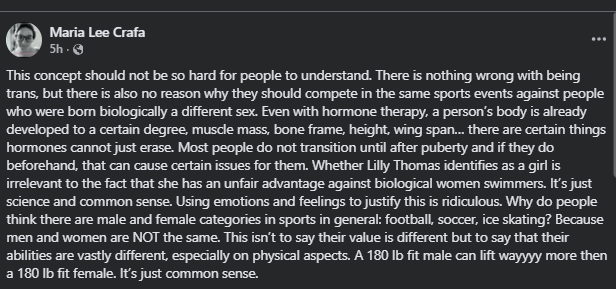
On Facebook, user Maria Lee Crafa posted a strong opinion in support of the ban.
The argument is that transgender women, like Lia Thomas, shouldn’t compete in women’s sports due to physical advantages from male puberty, like muscle mass and bone structure, which hormone therapy can’t fully reverse.
Separate male and female sports categories exist because men and women have different physical abilities, and fairness in competition relies on recognizing these differences, not just gender identity.
She wrote,
 (Source: )
“This concept should not be so hard for people to understand. There is nothing wrong with being trans, but there is also no reason why they should compete in the same sports events against people who were born biologically a different sex. “
Via FaebookSome celebrate the ban as a win for women’s sports. One user said,
“Big win for women’s sports! No man should compete as a woman, fairness isn’t optional. This is about protecting real athletes, not bending the rules. HE deserved to lose.”
ViaOthers point to real-world issues like skewed crime stats or prison incidents to argue for biology-based policies. But supporters of trans rights push back.
Another highlighted that Lia didn’t break any world or NCAA records, unlike swimmers like Katie Ledecky, questioning the fairness of the scrutiny.
Reactions from male athletes have added a surprising twist, with some expressing shock and others supporting the decision, leaving Lia and her supporters reeling.
At 26 years old, Lia expressed her disappointment in a statement to ESPN. She called the decision “a step backward for inclusivity.”
She argued that the policy disregards the lived experiences of transgender athletes and undermines their right to compete authentically.
“I’ve trained tirelessly to be where I am, and this feels like a punishment for who I am.”
ViaHer legal team is exploring options to challenge the ruling, possibly through the Court of Arbitration for Sport again. The IOC’s framework has withstood scrutiny in similar cases, but advocates hope for reform.
Supporters of the ban argue it addresses biological advantages, while critics view it as discriminatory.
They claim that the differences in physical capabilities between men and women are not entirely erased by hormone therapy, noting that transgender women may retain advantages from male puberty.
The National Women’s Law Center criticized the ban for compromising athletes’ needs, while swimmer Riley Gaines said it leaves women at a disadvantage.
This ruling has reignited debates around gender identity and fairness in sports, leaving opinions sharply divided.
- Check other Articles on
Reshma is a content editor recognized for her ability to create engaging digital content, ensure quality, and deliver stories that connect with audiences.
Related articles
May 13, 2026
May 12, 2026
May 12, 2026
May 8, 2026
Comments
LEAVE A REPLY
Comment: Please enter your comment! Name:* Please enter your name here Email:* You have entered an incorrect email address! Please enter your email address here
Δ
This site uses Akismet to reduce spam.
Share article
- May 13, 2026 Residents of Biggleswade, Bedfordshire, are raising serious concerns after a series of violent incidents involving a group of young boys who have been targeting...
- May 13, 2026 Andrew O' Donnell of Fairfield, Connecticut, passed away at the age of 39. He was born in Fairfield, Connecticut, and later moved to Ancramdale, New...
- May 12, 2026 Judy (Evans) Milby of Rockwall, Texas, passed away on Saturday at the age of 80. Milby was born on July 25, 1945, to her father,...
- May 12, 2026 Residents of Dromore, Co. Down, are calling for action after a deeply concerning incident at the local play park, where older children were reported...
- May 11, 2026 A video circulating on Facebook has sparked a heated debate among Bell Gardens residents after police were called on a group of kids riding...
